
Newsletter
CEG Newsletter Archive
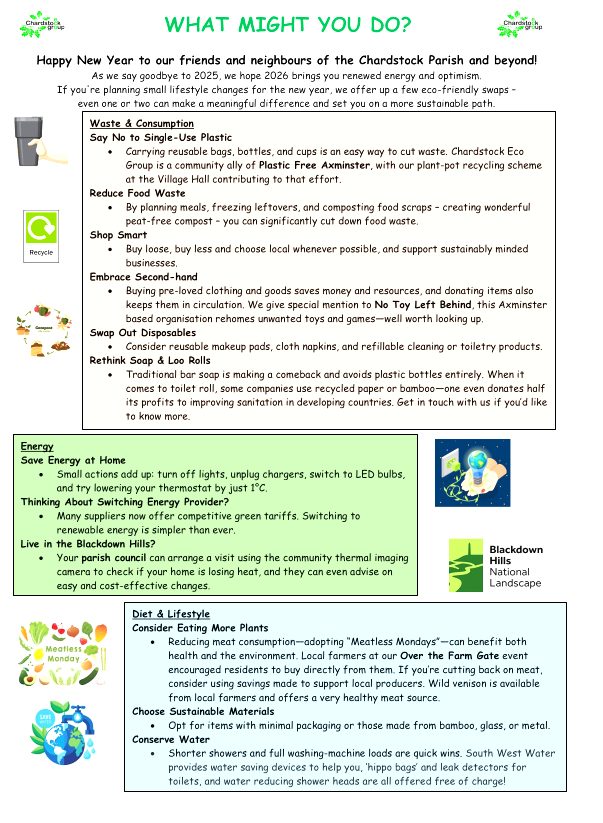
WHAT MIGHT YOU DO? Happy New Year to our friends and neighbours of the Chardstock Parish and beyond! As we say goodbye to 2025, we hope 2026 brings you renewed energy and optimism. If you're planning small lifestyle changes for the new year, we offer up a few eco-friendly swaps – even one or two can make a meaningful difference and set you on a more sustainable path.
Waste & Consumption
Say No to Single-Use Plastic
• Carrying reusable bags, bottles, and cups is an easy way to cut waste. Chardstock Eco
Group is a community ally of Plastic Free Axminster, with our plant-pot recycling scheme
at the Village Hall contributing to that effort.
Reduce Food Waste
• By planning meals, freezing leftovers, and composting food scraps – creating wonderful
peat-free compost – you can significantly cut down food waste.
Shop Smart
• Buy loose, buy less and choose local whenever possible, and support sustainably minded
businesses.
Embrace Second-hand
• Buying pre-loved clothing and goods saves money and resources, and donating items also
keeps them in circulation. We give special mention to No Toy Left Behind, this Axminster
based organisation rehomes unwanted toys and games—well worth looking up.
Swap Out Disposables
• Consider reusable makeup pads, cloth napkins, and refillable cleaning or toiletry products.
Rethink Soap & Loo Rolls
• Traditional bar soap is making a comeback and avoids plastic bottles entirely. When it
comes to toilet roll, some companies use recycled paper or bamboo—one even donates half
its profits to improving sanitation in developing countries. Get in touch with us if you’d like
to know more.
Energy
Save Energy at Home
• Small actions add up: turn off lights, unplug chargers, switch to LED bulbs,
and try lowering your thermostat by just 1°C.
Thinking About Switching Energy Provider?
• Many suppliers now offer competitive green tariffs. Switching to
renewable energy is simpler than ever.
Live in the Blackdown Hills?
• Your parish council can arrange a visit using the community thermal imaging
camera to check if your home is losing heat, and they can even advise on
easy and cost-effective changes.
Diet & Lifestyle
Consider Eating More Plants
• Reducing meat consumption—adopting “Meatless Mondays”—can benefit both
health and the environment. Local farmers at our Over the Farm Gate event
encouraged residents to buy directly from them. If you’re cutting back on meat,
consider using savings made to support local producers. Wild venison is available
from local farmers and offers a very healthy meat source.
Choose Sustainable Materials
• Opt for items with minimal packaging or those made from bamboo, glass, or metal.
Conserve Water
• Shorter showers and full washing-machine loads are quick wins. South West Water
provides water saving devices to help you, ‘hippo bags’ and leak detectors for
toilets, and water reducing shower heads are all offered free of charge!
Our next presentation
We look forward to welcoming you on Tuesday 13 January at 7pm for a presentation by the Axewoods
Co-operative. Axewoods helps woodland owners and gardeners by removing unwanted trees at no cost, then
seasoning and distributing the wood to people experiencing fuel poverty, via referrals from local agencies. All
presentations are free, with revenue from raffle tickets sales and donations covering our costs.
Get Involved
Learn Something New
• Chardstock Eco Group hosts free presentations on the second Tuesday of each
month, covering topics such as wildlife and the impacts of climate change. Talks are
free, as are the refreshments! Our 2026 programme has plenty of variety, so keep
an eye out for topics that interest you.
Join a Trip
• Later this year we’ll be visiting the Waste-to-Energy site in Exeter, where you can
see exactly what happens to the contents of your black bin.
Take Part in Citizen Science
• In partnership with the Devon Mammal Group, we’ll soon be hosting a barn owl pellet
dissection workshop. It’s a fascinating hands-on activity that helps identify harvest
mouse populations—a species currently in decline—and contributes to local
conservation efforts.
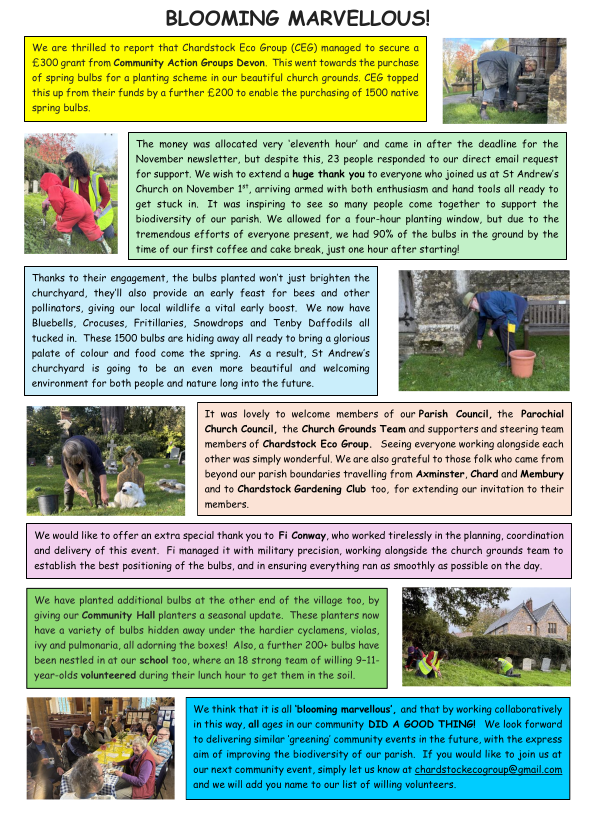
BLOOMING MARVELLOUS! We are thrilled to report that Chardstock Eco Group (CEG) managed to secure a £300 grant from Community Action Groups Devon. This went towards the purchase of spring bulbs for a planting scheme in our beautiful church grounds. CEG topped this up from their funds by a further £200 to enable the purchasing of 1500 native spring bulbs.
The money was allocated very ‘eleventh hour’ and came in after the deadline for the
November newsletter, but despite this, 23 people responded to our direct email request
for support. We wish to extend a huge thank you to everyone who joined us at St Andrew’s
Church on November 1st, arriving armed with both enthusiasm and hand tools all ready to
get stuck in. It was inspiring to see so many people come together to support the
biodiversity of our parish. We allowed for a four-hour planting window, but due to the
tremendous efforts of everyone present, we had 90% of the bulbs in the ground by the
time of our first coffee and cake break, just one hour after starting!
Thanks to their engagement, the bulbs planted won’t just brighten the
churchyard, they’ll also provide an early feast for bees and other
pollinators, giving our local wildlife a vital early boost. We now have
Bluebells, Crocuses, Fritillaries, Snowdrops and Tenby Daffodils all
tucked in. These 1500 bulbs are hiding away all ready to bring a glorious
palate of colour and food come the spring. As a result, St Andrew’s
churchyard is going to be an even more beautiful and welcoming
environment for both people and nature long into the future.
It was lovely to welcome members of our Parish Council, the Parochial
Church Council, the Church Grounds Team and supporters and steering team
members of Chardstock Eco Group. Seeing everyone working alongside each
other was simply wonderful. We are also grateful to those folk who came from
beyond our parish boundaries travelling from Axminster, Chard and Membury
and to Chardstock Gardening Club too, for extending our invitation to their
members.
We would like to offer an extra special thank you to Fi Conway, who worked tirelessly in the planning, coordination
and delivery of this event. Fi managed it with military precision, working alongside the church grounds team to
establish the best positioning of the bulbs, and in ensuring everything ran as smoothly as possible on the day.
We have planted additional bulbs at the other end of the village too, by
giving our Community Hall planters a seasonal update. These planters now
have a variety of bulbs hidden away under the hardier cyclamens, violas,
ivy and pulmonaria, all adorning the boxes! Also, a further 200+ bulbs have
been nestled in at our school too, where an 18 strong team of willing 9–11-
year-olds volunteered during their lunch hour to get them in the soil.
We think that it is all ‘blooming marvellous’, and that by working collaboratively
in this way, all ages in our community DID A GOOD THING! We look forward
to delivering similar ‘greening’ community events in the future, with the express
aim of improving the biodiversity of our parish. If you would like to join us at
our next community event, simply let us know at chardstockecogroup@gmail.com
and we will add you name to our list of willing volunteers.
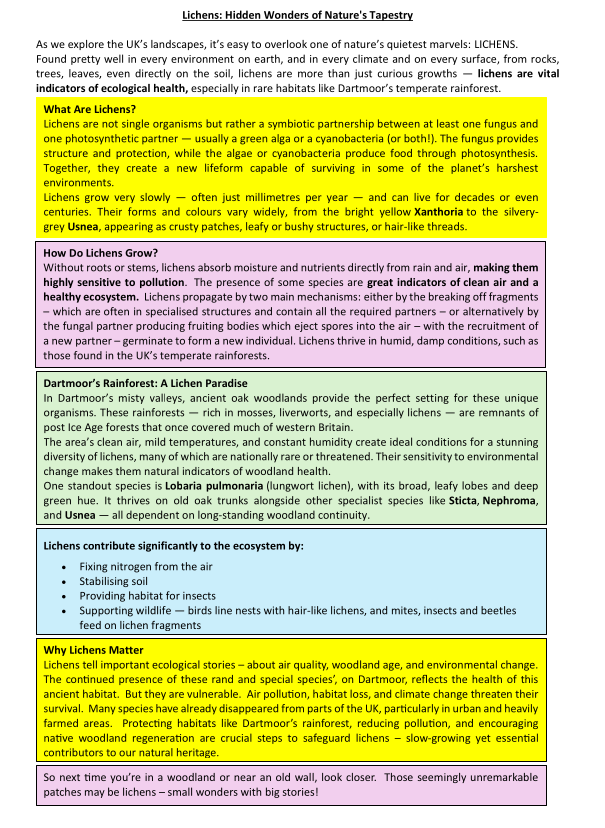
Lichens: Hidden Wonders of Nature's Tapestry. As we explore the UK’s landscapes, it’s easy to overlook one of nature’s quietest marvels: LICHENS. Found pretty well in every environment on earth, and in every climate and on every surface, from rocks,
trees, leaves, even directly on the soil, lichens are more than just curious growths — lichens are vital
indicators of ecological health, especially in rare habitats like Dartmoor’s temperate rainforest.
How Do Lichens Grow?
Without roots or stems, lichens absorb moisture and nutrients directly from rain and air, making them
highly sensitive to pollution. The presence of some species are great indicators of clean air and a
healthy ecosystem. Lichens propagate by two main mechanisms: either by the breaking off fragments
– which are often in specialised structures and contain all the required partners – or alternatively by
the fungal partner producing fruiting bodies which eject spores into the air – with the recruitment of
a new partner – germinate to form a new individual. Lichens thrive in humid, damp conditions, such as
those found in the UK’s temperate rainforests.
Dartmoor’s Rainforest: A Lichen Paradise
In Dartmoor’s misty valleys, ancient oak woodlands provide the perfect setting for these unique
organisms. These rainforests — rich in mosses, liverworts, and especially lichens — are remnants of
post Ice Age forests that once covered much of western Britain.
The area’s clean air, mild temperatures, and constant humidity create ideal conditions for a stunning
diversity of lichens, many of which are nationally rare or threatened. Their sensitivity to environmental
change makes them natural indicators of woodland health.
One standout species is Lobaria pulmonaria (lungwort lichen), with its broad, leafy lobes and deep
green hue. It thrives on old oak trunks alongside other specialist species like Sticta, Nephroma,
and Usnea — all dependent on long-standing woodland continuity.
Lichens contribute significantly to the ecosystem by:
• Fixing nitrogen from the air
• Stabilising soil
• Providing habitat for insects
• Supporting wildlife — birds line nests with hair-like lichens, and mites, insects and beetles
feed on lichen fragments
What Are Lichens?
Lichens are not single organisms but rather a symbiotic partnership between at least one fungus and
one photosynthetic partner — usually a green alga or a cyanobacteria (or both!). The fungus provides
structure and protection, while the algae or cyanobacteria produce food through photosynthesis.
Together, they create a new lifeform capable of surviving in some of the planet’s harshest
environments.
Lichens grow very slowly — often just millimetres per year — and can live for decades or even
centuries. Their forms and colours vary widely, from the bright yellow Xanthoria to the silvery-
grey Usnea, appearing as crusty patches, leafy or bushy structures, or hair-like threads.
Why Lichens Matter
Lichens tell important ecological stories – about air quality, woodland age, and environmental change.
The continued presence of these rand and special species’, on Dartmoor, reflects the health of this
ancient habitat. But they are vulnerable. Air pollution, habitat loss, and climate change threaten their
survival. Many species have already disappeared from parts of the UK, particularly in urban and heavily
farmed areas. Protecting habitats like Dartmoor’s rainforest, reducing pollution, and encouraging
native woodland regeneration are crucial steps to safeguard lichens – slow-growing yet essential
contributors to our natural heritage.
So next time you’re in a woodland or near an old wall, look closer. Those seemingly unremarkable
patches may be lichens – small wonders with big stories!
‘A Lovely Look at Lichens’!
You don’t need to travel to Dartmoor to see amazing lichens — you can see some wonderful specimens
right on our doorstep! Chardstock Eco Group organised a morning trip to Dennings Down Farm – just
outside Smallridge – on Tuesday 28th October. This woodland wander and classroom session was led by
local lichen enthusiast Fred Gibson from Axminster, ably supported by fellow lichen enthusiast Sonia
Mistley. Fred and Sonia are part of the South West Lichen Group of the British Lichen Society, and Fred
recently helped provide lichen expertise to Devon Wildlife Trust’s ‘Saving Devon Treescapes’ citizen science
lichen project. Spaces were limited and proved to be in pretty high demand. Fred and Sonia generously
shared their vast knowledge and passion throughout the day. Their ability to bring the tiny, intricate world
of lichens to life was a highlight for us all. We are so grateful for the time and expertise they offered in
guiding us through this activity.
Dennings Down provided the perfect setting, its rolling landscape, thriving habitats, and the beautiful oak-
framed classroom offered a wonderful space to learn, connect, and reflect. Whilst the curiosity and
enthusiasm of the group made the day truly special. It was inspiring to see so many people come together
to explore the fascinating world of lichens and to contribute to a better understanding of the rich
biodiversity found there. It seemed everyone left with a deeper appreciation for lichens and for the
landscapes they inhabit.
Interested in joining us on similar events in the future? Keep an eye on your inbox for opportunities offered
by us, we are hopeful that our next event may be a barn owl pellet dissection workshop, so watch this
space!
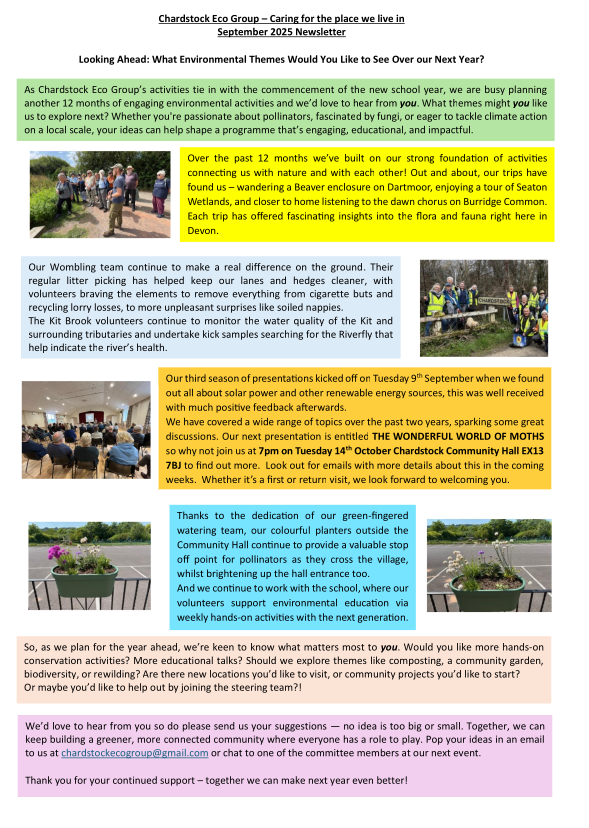
Chardstock Eco Group – Caring for the place we live in. September 2025 Newsletter. Looking Ahead: What Environmental Themes Would You Like to See Over our Next Year? Our Wombling team continue to make a real difference on the ground. Their
regular litter picking has helped keep our lanes and hedges cleaner, with
volunteers braving the elements to remove everything from cigarette buts and
recycling lorry losses, to more unpleasant surprises like soiled nappies.
The Kit Brook volunteers continue to monitor the water quality of the Kit and
surrounding tributaries and undertake kick samples searching for the Riverfly that
help indicate the river’s health.
Thanks to the dedication of our green-fingered
watering team, our colourful planters outside the
Community Hall continue to provide a valuable stop
off point for pollinators as they cross the village,
whilst brightening up the hall entrance too.
And we continue to work with the school, where our
volunteers support environmental education via
weekly hands-on activities with the next generation.
Over the past 12 months we’ve built on our strong foundation of activities
connecting us with nature and with each other! Out and about, our trips have
found us – wandering a Beaver enclosure on Dartmoor, enjoying a tour of Seaton
Wetlands, and closer to home listening to the dawn chorus on Burridge Common.
Each trip has offered fascinating insights into the flora and fauna right here in
Devon.
Our third season of presentations kicked off on Tuesday 9th September when we found
out all about solar power and other renewable energy sources, this was well received
with much positive feedback afterwards.
We have covered a wide range of topics over the past two years, sparking some great
discussions. Our next presentation is entitled THE WONDERFUL WORLD OF MOTHS
so why not join us at 7pm on Tuesday 14th October Chardstock Community Hall EX13
7BJ to find out more. Look out for emails with more details about this in the coming
weeks. Whether it’s a first or return visit, we look forward to welcoming you.
So, as we plan for the year ahead, we’re keen to know what matters most to you. Would you like more hands-on
conservation activities? More educational talks? Should we explore themes like composting, a community garden,
biodiversity, or rewilding? Are there new locations you’d like to visit, or community projects you’d like to start?
Or maybe you’d like to help out by joining the steering team?!
We’d love to hear from you so do please send us your suggestions — no idea is too big or small. Together, we can
keep building a greener, more connected community where everyone has a role to play. Pop your ideas in an email
to us at chardstockecogroup@gmail.com or chat to one of the committee members at our next event.
Thank you for your continued support – together we can make next year even better!
As Chardstock Eco Group’s activities tie in with the commencement of the new school year, we are busy planning
another 12 months of engaging environmental activities and we’d love to hear from you. What themes might you like
us to explore next? Whether you're passionate about pollinators, fascinated by fungi, or eager to tackle climate action
on a local scale, your ideas can help shape a programme that’s engaging, educational, and impactful.